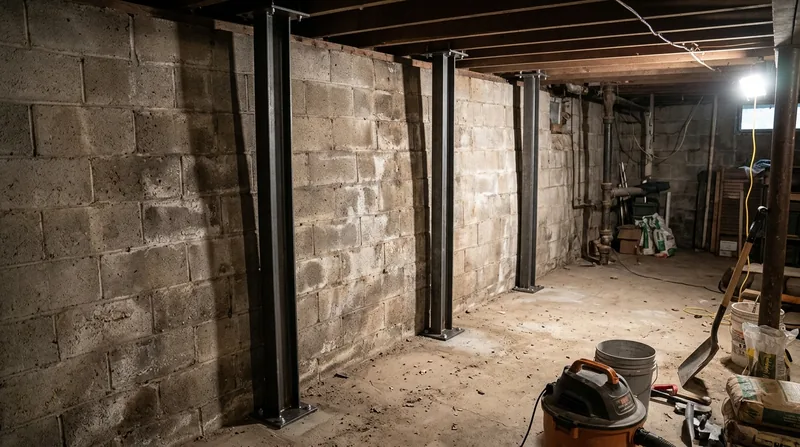




Most of the homes we open up around Concord were never built with a full basement in mind. The 1900s mill houses in Cannon Village and near downtown have stone or brick cellars, and the 1950s brick ranches out toward Harrisburg and Kannapolis sit on slab or raised piers. When a wall does start to lean, it is usually a block or brick wall holding back wet Piedmont clay after a long rainy stretch, and that is where Bowing Wall Repair in Concord earns its keep. We read the movement first, then match the fix to the pressure behind the wall. If the wall is still standing straight and the problem is water, start with our basement waterproofing service and we will tell you plainly whether you even need structural work.
Why Bowing Walls Show Up in Concord's Older Brick and Block
The ground here is red Piedmont clay over weathered granite, and shallow rock turns up in plenty of yards. Clay swells when it takes on water and pushes hard against any wall holding it back. Add our freeze-thaw mornings in January and February and a wall that was already leaning a quarter inch can move faster than the homeowner expects. The older cellars in Cannon Village and the brick foundations near downtown Concord carry the most of it, because the block and mortar from that era were never designed for today's runoff volumes.
- Hydrostatic pressure builds when clay stays saturated for weeks after summer thunderstorms and pushes the wall inward.
- Horizontal cracks in a block wall, especially at mid-height, signal pressure from the soil side, not settlement from below.
- Efflorescence, that white salt bloom on the block face, tells you water is moving through the wall and drying on the inside.
- Sticking doors and windows, or a floor that has pulled away from the wall plate, point to movement that needs to be measured, not guessed at.
- Downspouts that dump next to the foundation and grading that slopes back toward the house feed the same clay that is pushing on the wall.
None of those signs means the house is coming down tomorrow, but each one is a reason to get the wall measured before the next wet season.
Key info: A block wall in a 1920s Cannon Village cellar that leans a half inch over eight feet is a different job from a wall that has moved two inches. We measure the deflection and check the mortar joints before we quote anything, because a strap job on a wall that needs anchors is money wasted.
For the code side, structural foundation repair permits are handled by the local building department, and requirements vary by jurisdiction, so confirm the current rule before work starts. The City of Concord's permit office is the right place to check: concordnc.gov.
How We Stabilize a Leaning Wall on a Concord Foundation
We start by getting the water story straight, because a wall pushed by saturated clay will keep moving until the water is managed. That means checking the footing drain, the grading, and where the downspouts land before we touch the wall itself. Then we measure the bow, set the repair, and verify it held. On the older brick foundations near downtown Concord, we often pair the structural fix with crack work so the wall is not just straight but dry.
- We walk the inside and outside of the foundation and record the deflection with a string line and level at three heights.
- We check the footing drain and the soil side for trapped water, since hydrostatic pressure is usually the driver behind the movement.
- We recommend the lightest method that will hold: carbon fiber straps for a wall that has moved less than about two inches, wall anchors or steel I-beams when the bow is deeper or the block is cracked through.
- We excavate and install anchors from the outside where the soil allows, or work from the inside with beams and a footing bracket where access is tight.
- We seal active cracks with epoxy injection or polyurethane injection depending on whether the crack is moving or just leaking.
- We correct the grading and extend downspouts so the clay behind the wall stops reloading with water.
Every job ends with a measurement sheet so you can see what the wall did and what it should do over the next year.
Key info: On a 1960s brick ranch in Harrisburg, the back wall had bowed about an inch and a half after a wet spring. We installed carbon fiber straps on the inside, injected the stair-step crack at the corner, and ran a downspout extension out to the ditch. The wall has not moved since, and the homeowner did not need excavation.
If the inspection shows the wall is dry but the crack is the only issue, our foundation crack repair page covers the injection options in detail. If the wall is moving and the footing drain is failed, we look at the full foundation waterproofing scope before recommending structural work.
Bowing Wall Repair Methods We Use in Concord
The method follows the severity of the movement and the pressure of the wet clay behind the wall. We do not sell the heaviest fix to every homeowner, and we do not strap a wall that has already cracked through the block. Here is how the options compare on the foundations we see around Concord, Kannapolis, and Mount Pleasant.
| Approach | Description | Best for |
|---|---|---|
| Carbon fiber straps | Straps bonded to the inside face of the wall and anchored top and bottom to stop further bowing. | Block walls with less than about two inches of deflection and no through-cracks. |
| Steel I-beams | Vertical beams set against the wall and tied into the floor and joists to brace the wall from the inside. | Deeper bows, or where outside access is blocked by a driveway or a neighbor's lot line. |
| Wall anchors | Steel plates on the inside tied to earth anchors buried out in the yard, pulling the wall back over time. | Walls that need to be straightened, not just held, where the yard gives us room to dig. |
| Epoxy or polyurethane injection | Ports set into the crack and resin pumped in to fill it and stop water and air movement. | Cracks that are leaking or that need to be tied back together before strapping. |
| Grading and downspout correction | Regrading the soil to slope away and extending downspouts to move roof water off the foundation. | Every job, because the clay behind the wall has to stop reloading with water. |
Bowing Wall Repair Cost in Concord: What to Expect
Most bowing wall work in Concord starts at $600 for the smallest scopes, such as a single injected crack with a grading correction, and climbs from there. A carbon fiber strap job on a typical block wall usually runs into the low thousands per wall, and wall anchors or I-beams go higher because of the excavation and steel. The number that matters is the one after we measure the bow, not a phone estimate.
What moves the price: how far the wall has moved, whether the block is cracked through, whether we can dig on the outside or have to work from inside, and whether the footing drain and grading need to be corrected at the same time. Access matters too, since a wall behind a finished basement or a tight lot line takes more time to brace. That is why we recommend two or three written estimates with the same scope spelled out, so you are comparing the same work and not a cheap strap quote against a full anchor job.
Our pricing page lays out the ranges we work from. We would rather give you a real range up front than a low number that grows once we open the wall.
Choosing a Bowing Wall Repair Contractor Near Me in Concord
Bowing wall work is a small niche, and a lot of the quotes homeowners get in Concord come from general foundation firms or from waterproofers who only do drain tile. Ask what method they propose and why, and ask to see the measurement they based it on. A contractor who cannot explain the difference between a strap and an anchor, or who quotes a structural repair without checking the water behind the wall, is not the one to hire.
- Confirm the company is licensed and insured, and ask for a certificate of insurance before work starts.
- Get two or three written estimates that list the same method and scope, so the comparison is real.
- Ask for references from jobs in Concord or the surrounding towns, and call at least one of them.
- Ask who pulls the structural foundation repair permit, since the local building department requires one and the rule varies by jurisdiction.
- Check any HOA or historic district requirements for the neighborhood, especially in the older parts of downtown Concord.
We are happy to walk you through our method and our measurement sheet before you sign anything. Reach us through our contact page or call (980) 680-6560.
If you are in one of the outlying towns, the local pages for Kannapolis and Harrisburg cover the building stock we see there. The work is the same, the walls are different.
Bowing Wall Repair in Concord: Pricing Guide
| Service | Price | Details |
|---|---|---|
| Crack injection and grading correction | Starting at $600 | Includes epoxy or polyurethane injection on one crack plus downspout extension and regrading at the foundation. |
| Carbon fiber strap installation | Starting at $1,400 | Per wall, including surface prep and anchoring; price rises with wall length and number of straps needed. |
| Steel I-beam bracing | Starting at $2,800 | Interior beam set and tied into floor and joists; cost moves with beam count and basement access. |
| Wall anchor system | Starting at $4,500 | Includes exterior excavation, earth anchors, and inside plates; price depends on yard access and soil depth. |
| Complex or large-scale job | On estimate | Multi-wall movement, through-cracks, or failed footing drain need an on-site look before we quote. |
| Estimate | Free | On-site measurement and written scope within 24 hours at (980) 680-6560, no obligation to book. |
Indicative pricing, the exact cost depends on square footage, finish, and site access. Free personalized estimate within 24h at (980) 680-6560.


