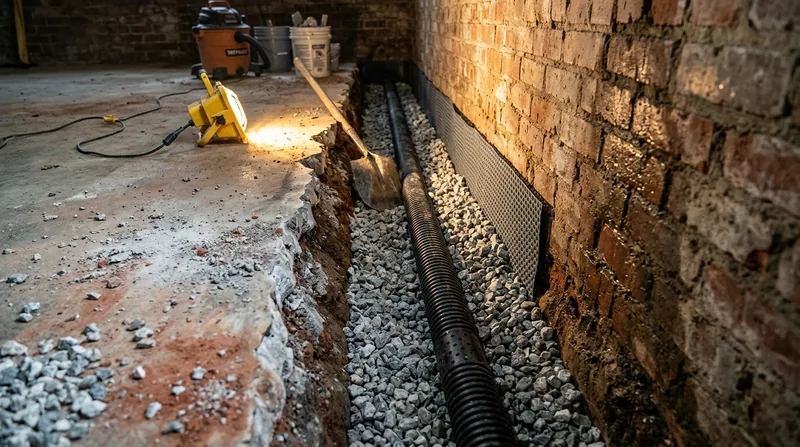




Interior Drain Tile System in Concord: The Fix for Water Under the Slab
Concord sits on red Piedmont clay over weathered granite, and that clay does one thing very well: it holds storm water against your foundation footing until the pressure finds a seam. If you have water in the basement after a hard summer thunderstorm or a slow winter drizzle, an Interior Drain Tile System in Concord is the proven answer. We cut a channel along the inside of the footing, set perforated drain tile in washed stone, and pipe every drop to a sump basin that pumps it away from the house. This is not exterior excavation, and it is not a bucket in the corner. It is a permanent below-grade drainage path installed under your slab, and it works in any season. If you are still sorting out whether the problem is a crack or the water table, start with a free basement inspection and we will tell you plainly which one it is.
Why Hydrostatic Pressure Beats Up Concord Foundations
The building stock here explains most of the calls we get. The 1900s to 1950s mill houses in Cannon Village and near downtown Concord have stone and brick cellars that were never damp-proofed, so water wicks straight through the mortar. The 1950s to 1970s brick ranches in Kannapolis, Harrisburg, and the older Concord neighborhoods sit on slab or raised piers, and when they do have a basement, the footing drain is usually clay tile that has collapsed or silted shut. Add the flashy runoff from Rocky River and Coddle Creek after a storm, and the red clay has nowhere to send the water but under your floor. That is hydrostatic pressure, and no coat of sealer on the wall stops it.
- Water pools against the footing because the clay drains at a crawl, not because your downspouts are broken.
- Efflorescence appears as a white powder on the block, which means moisture is moving through the masonry, not sitting on it.
- The basement smells musty in July and August, when humid air meets a cold slab and condenses.
- The sump pump runs long after the rain stops, a sign the water table is still feeding the basin.
- A crack that was dry in October weeps in February, when freeze-thaw mornings open the joint.
If two or more of those sound familiar, the wall is telling you the drain at the footing has failed, and an interior perimeter drain is the correction.
Key info: A homeowner in Cannon Village had a stone cellar that took on two inches of water every time a summer storm parked over downtown Concord. The brick was sound, the crack was minor, and the real problem was a collapsed clay footing drain. We installed an interior drain tile system and a new sump basin, and the floor has stayed dry through three hurricane remnants since.
For the broader picture of how below-grade water control fits together, the basement waterproofing service page lays out the full sequence. The City of Concord also publishes permit and inspection information if you want to confirm what your project requires before work begins.
How We Install an Interior Drain Tile System in Concord
We do not guess at the layout. The first step is finding where the water actually enters, because a crack in the middle of the wall and a saturated footing call for different work. On a slab-on-grade ranch in Harrisburg, we may find the water is coming from a failed downspout and grading, in which case we say so and skip the drain. On a full basement with a wet perimeter, we cut, lay tile, and pipe it to a basin. Every job follows the same sequence, and you see each stage before we close it up.
- We walk the basement and the exterior grade, then mark the high-water lines and any efflorescence so we know the wet elevation.
- We saw-cut a channel roughly 12 inches wide along the interior face of the footing, breaking out the slab cleanly.
- We excavate to the footing and confirm the drain tile sits below the slab, not beside it.
- We set perforated drain tile in washed #57 stone, wrap it in filter fabric, and slope it to the sump basin.
- We set the sump basin, plumb the discharge line through the wall or floor, and install a check valve.
- We backfill with stone, pour a new concrete apron over the channel, and test the pump with a full basin.
- We point the discharge line to a daylight outlet or a dry well that clears the foundation by at least 10 feet.
Every installation ends with a wet test, not a handshake, because a drain that does not move water is just a trench.
Key info: On a 1960s brick ranch in Kannapolis, the footing drain had silted solid and the basement flooded every March. We ran 94 linear feet of interior drain tile to a new basin, tied in a sump pump installation, and the discharge now runs to a dry well 12 feet off the corner. The owner has not wet-vacuumed the floor since.
Interior Drain Tile Approaches We Use in Concord
Not every basement gets the same system. The right approach depends on whether you have a full basement, a partial cellar, or a slab with a shallow footing, and on how much water the clay is pushing. Here is how we match the method to the house.
| Approach | Description | Best for |
|---|---|---|
| Full interior perimeter drain | Drain tile runs the entire inside face of the footing, feeding one or more sump basins. | Full basements with water along two or more walls. |
| Partial drain tile run | Tile is installed only along the wet wall and tied to a basin or existing drain. | One-wall seepage on a partial cellar or a walkout lot. |
| Drain tile plus wall membrane | Dimple board or a waterproof membrane is applied to the wall above the new drain. | Block walls with efflorescence and damp masonry. |
| Drain tile and crack injection combo | Epoxy or polyurethane injection closes active cracks, then the drain handles the footing water. | Homes with both a weeping crack and a wet perimeter. |
| Drain tile repair and replacement | We cut out failed clay or collapsed tile and replace it with perforated PVC and new stone. | Older homes where a footing drain already exists but has failed. |
We will tell you which row fits your basement after we see it, and we will tell you when a simpler fix is enough.
Interior Drain Tile System Cost in Concord: What to Expect
Most interior drain tile work in the Concord area starts at From $50 per linear foot, and that figure is a starting point, not a quote. A straight run along one wall of a 1950s brick ranch in Harrisburg is on the low end. A full perimeter around a stone cellar in Cannon Village with shallow rock under the footing, a new sump basin, and a discharge line to daylight is on the high end, and the footage alone will not tell you which one you have. We price the job after we see the footing depth, the access, and whether the discharge can gravity-feed or needs a pump.
Two or three estimates is the right move, and we say that as a contractor who wants the work. Ask each bidder what happens to the discharge water, whether the price includes the sump basin and check valve, and how they handle rock. A low number that stops at the trench and leaves you buying the pump is not a low number. Our full pricing overview breaks down the line items so you can compare bids on equal terms.
Hiring a Waterproofing Contractor Near Me in Concord: What to Check
This trade has a low barrier to entry, and the companies that do it well are the ones that will show you paperwork without being asked. You want a licensed and insured contractor who specializes in below-grade water control, not a general handyman with a saw and a shovel. Ask for the certificate of insurance, call two references from jobs within the last year, and confirm who pulls the permit if your city requires one for work that alters drainage or the sump discharge connection. Rules vary by jurisdiction, so verify with the local building department before the crew arrives.
If your neighborhood has an HOA, check the architectural rules before you cut concrete or change where the discharge exits the house. And if the work touches a structural footing, get the scope in writing. We are happy to walk you through our license and coverage before you sign anything, and you can reach us through the contact page to set that up.
Interior Drain Tile System in Concord: Pricing Guide
| Service | Price | Details |
|---|---|---|
| Partial interior drain tile run | Starting at $50/linear ft | Includes saw-cut, excavation to footing, perforated tile in washed stone, and concrete patch over the channel. |
| Full interior perimeter drain | Starting at $55/linear ft | Covers all four walls plus sump basin, check valve, and discharge line routed clear of the foundation. |
| Drain tile plus sump pump package | Starting at $65/linear ft | Adds a new sump pump and basin to the perimeter run, with wet test before we close the floor. |
| Drain tile repair and replacement | On estimate | Failed clay or collapsed tile requires an on-site look to confirm footage and footing access. |
| Travel | Included | In Concord and surrounding areas, no separate call-out or mileage fee. |
| Estimate | Free | Response within 24h at (980) 680-6560, no obligation to book. |
Indicative pricing, the exact cost depends on square footage, finish, and site access. Free personalized estimate within 24h at (980) 680-6560.


